
Four astronauts are currently on their way home from the Moon. NASA has released images that take your breath away. But what would these images sound like if you had to create a soundtrack for them?
Images from the dark side
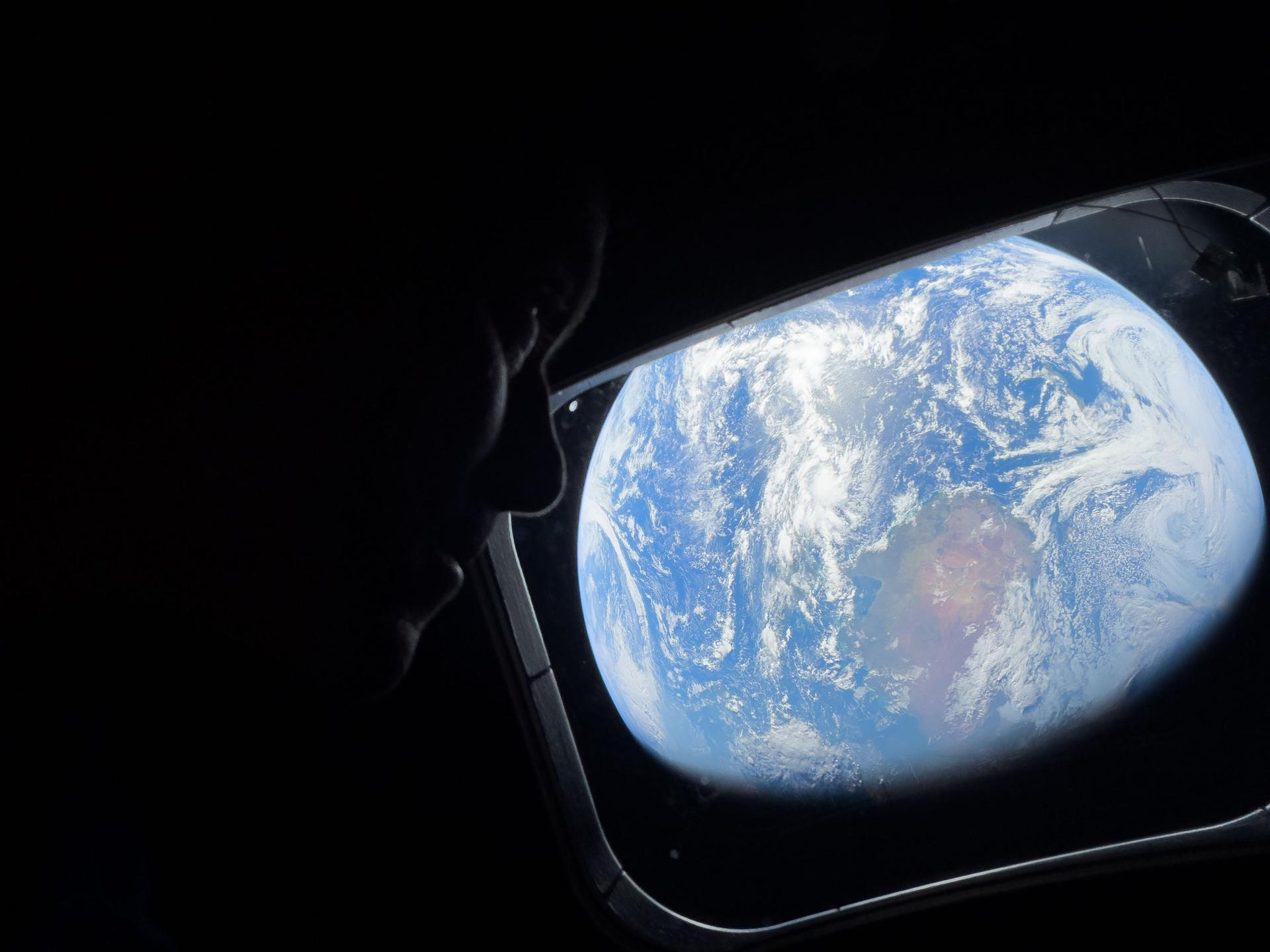
On April 7, 2026, NASA shared new photographs from the Orion spacecraft. Taken by the astronauts aboard, as they flew around the Moon - through windows, with a Nikon camera, 400,000 kilometers from everything we know.
The images show the Moon's horizon (what NASA calls the lunar limb), craters on the far side of the Moon that can never be seen from Earth, and a moment where the Moon blocks the Sun, revealing a view that only a handful of people in history have ever witnessed.
At 01:07 CET, the crew set a new record: 406,777.8 kilometers from Earth - the farthest distance any human has ever been from our planet. The Apollo 13 crew's record from 1970 of 400,171 km was broken.
The Artemis II Crew
- • Reid Wiseman (USA) - Commander
- • Victor Glover (USA) - Pilot, first person of color on a lunar mission
- • Christina Koch (USA) - Mission Specialist, first woman on a lunar mission
- • Jeremy Hansen (Canada) - Mission Specialist, first non-American on a lunar mission
What would the Moon sound like?
In space, there is no sound. No air, no molecules to carry sound waves. Total silence. But when we see these images - the craters, the horizon, Earth's blue sphere behind the Moon's dark surface - we hear something inside us. Our brain wants to create a sound for what we see.
As music producers and sound designers, that's exactly what we do: We create sonic landscapes for emotions and images. And NASA's new Artemis images are the ultimate brief.
Sound design challenge: Create your own Moon soundtrack
Open Ableton Live, Vital, or your preferred DAW. Look at NASA's images and try to create a sonic landscape that matches the mood. Here are some starting points:
- • Granular synthesis - perfect for creating textures that feel like the lunar surface
- • Long reverb tails - ironic, since space has no reverb at all
- • Sub-bass drones - the deep vibration of something vast and unknown
- • Processed field recordings - NASA actually releases sounds from space converted to audible frequencies
Interstellar (Hans Zimmer), 2001: A Space Odyssey (Ligeti/Strauss) and Gravity (Steven Price) - three films that each gave space a unique sound. Zimmer used a massive church organ. Ligeti and Strauss provided the eerie and majestic soundscapes for Kubrick's vision. Price used vibrations transmitted through the spacesuit's materials.
Listen to iconic space film soundtracks:
A global journey to the Moon
Artemis II is not just an American mission - it's the culmination of 67 years of global lunar exploration. Let's take a tour through history and the countries that have shaped our understanding of Earth's closest neighbor.
The Soviet Union: The pioneers

The race to the Moon didn't begin with Neil Armstrong, but with a Soviet metal sphere. On September 13, 1959, Luna 2 crashed into the Moon, becoming the first human-made object to reach another celestial body. Just three weeks later, Luna 3 sent back the very first photographs of the Moon's far side - the side we never see from Earth.
On February 3, 1966, Luna 9 achieved the first controlled soft landing on the Moon. And in 1970, the Soviet Union accomplished something still impressive today: Luna 16 robotically collected 101 grams of lunar soil and returned it to Earth on September 24, 1970 - no humans required.
That same year, Lunokhod 1 rolled onto the lunar surface as the first rover on another celestial body, operating for 10 months. Lunokhod 2 followed in 1973, covering an impressive 39 kilometers.
Soundtrack inspiration: The Soviet era
Think analog synthesis, Soviet-era electronic music. Composers like Eduard Artemyev created soundtracks for Tarkovsky's space films using the ANS synthesizer - a unique Russian instrument that converted images to sound. Perfectly circular inspiration.

Apollo: Humans on the Moon
On December 24, 1968, the crew of Apollo 8 - Frank Borman, James Lovell, and William Anders - became the first humans to see Earth rise above the Moon's horizon. The famous "Earthrise" photo forever changed our perspective on our own planet.
Seven months later, on July 20, 1969, Neil Armstrong set foot on the Moon with the words: "That's one small step for man, one giant leap for mankind." Buzz Aldrin followed, while Michael Collins orbited the Moon in the command module.
Apollo 13 (April 1970) became the "successful failure" - an oxygen tank explosion crippled the spacecraft, forcing the crew to use the Lunar Module as a lifeboat. They reached 400,171 km from Earth - a record that stood for 56 years, until Artemis II broke it this week.
The final visit came with Apollo 17 in December 1972. Eugene Cernan became the "last man on the Moon," and geologist Harrison Schmitt became the first scientist to walk on the surface. No humans returned - until now.
China: The new space power
China's Chang'e program (named after the Chinese Moon goddess) has, within a decade, established the country as a serious space power.
On December 14, 2013, Chang'e 3 landed on the Moon and deployed the Yutu (Jade Rabbit) rover - China's first lunar landing. But the real breakthrough came on January 3, 2019, when Chang'e 4 became the first spacecraft ever to soft-land on the Moon's far side, in the Von Karman crater. The Yutu-2 rover is still active.
In December 2020, Chang'e 5 returned 1,731 grams of lunar material to Earth - the first lunar samples since the Soviet Union's Luna 24 in 1976. And in June 2024, Chang'e 6 did something no one had done before: It collected samples from the Moon's far side.
India: Conqueror of the South Pole
India's Chandrayaan-1 (2008) was an orbiter that didn't land, but delivered one of the most important discoveries in space exploration history: Definitive evidence of water ice on the Moon, detected by NASA's Moon Mineralogy Mapper instrument aboard the Indian spacecraft.
On August 23, 2023, Chandrayaan-3 became the first spacecraft ever to land near the Moon's south pole - an area of immense scientific interest for its potential water ice deposits. India became the fourth country to soft-land on the Moon, after the Soviet Union, the USA, and China.
Japan: The Moon Sniper
Japan's SLIM mission (Smart Lander for Investigating Moon) landed on January 19, 2024, demonstrating a precision landing within 100 meters of its target - earning the nickname "Moon Sniper." Despite landing upside down, it survived and transmitted data home.
Europe and Israel
ESA's SMART-1 orbited the Moon from 2004 to 2006, testing solar-powered ion propulsion. But Europe's most important contribution to lunar exploration is Orion's European Service Module - the engine and supply unit keeping the Artemis II crew alive. In return, ESA has secured seats for European astronauts on Artemis IV and V.
In 2019, Israel attempted to become the fourth country to land on the Moon with Beresheet - the world's first privately funded lunar mission. It achieved lunar orbit but crashed during the landing attempt on April 11, 2019.
Space as a sonic landscape
Each of these moments has its own acoustic signature. Not literally - but emotionally. And that's exactly what a producer or sound designer works with.
Luna 2 impact (1959)
Metal against regolith. Think industrial noise, distortion, granular synthesis with short grains. Massive impact followed by absolute silence.
Earthrise (1968)
Reverent, humbling, vast. String ensemble with long, floating chords. Pad synthesis with slow modulation. Ambient in its purest form.
The far side (2019)
The unknown. No human has seen it with their own eyes. Wavetable synthesis, spectral processing, sounds that morph and never quite resolve.
Artemis II record (2026)
406,777 km from everything you know. Sub-bass slowing to a crawl. Granular time-stretch of radio static. Infinity as frequency.
From the Moon to your studio
Artemis II is not just a technical achievement. It's a moment that reminds us how small we are - and how great the things we can create. Including music.
The images from Orion show us something no living person has seen with their own eyes in over 50 years. The craters, the shadows, the blue glimmer of our planet behind the Moon's horizon. And our brains automatically fill the silence with something - a drone, a tone, a feeling.
That's sound design. That's music production. That's what we do.
If you want to learn to create the sonic landscapes you hear inside when you see these images, our Sound Design course or Ableton Level 1 is a great place to start.
All NASA images from Artemis II are public domain and freely available
See all Artemis II images on nasa.gov →Stay updated
Get more articles like this
Subscribe to our newsletter and receive new guides, tips, and tutorials directly in your inbox.
No spam. Unsubscribe at any time.
Om forfatteren

Ras 'Kata' Kjærbo
Ras Kjærbo is an Ableton Certified Trainer and one of the driving forces behind Rumkraft. He teaches Ableton Live and music production, and is passionate about sharing his knowledge on everything from sound design to live performance techniques.